Meat in Israel: the illustrated guide to the numbers, with Hebrew
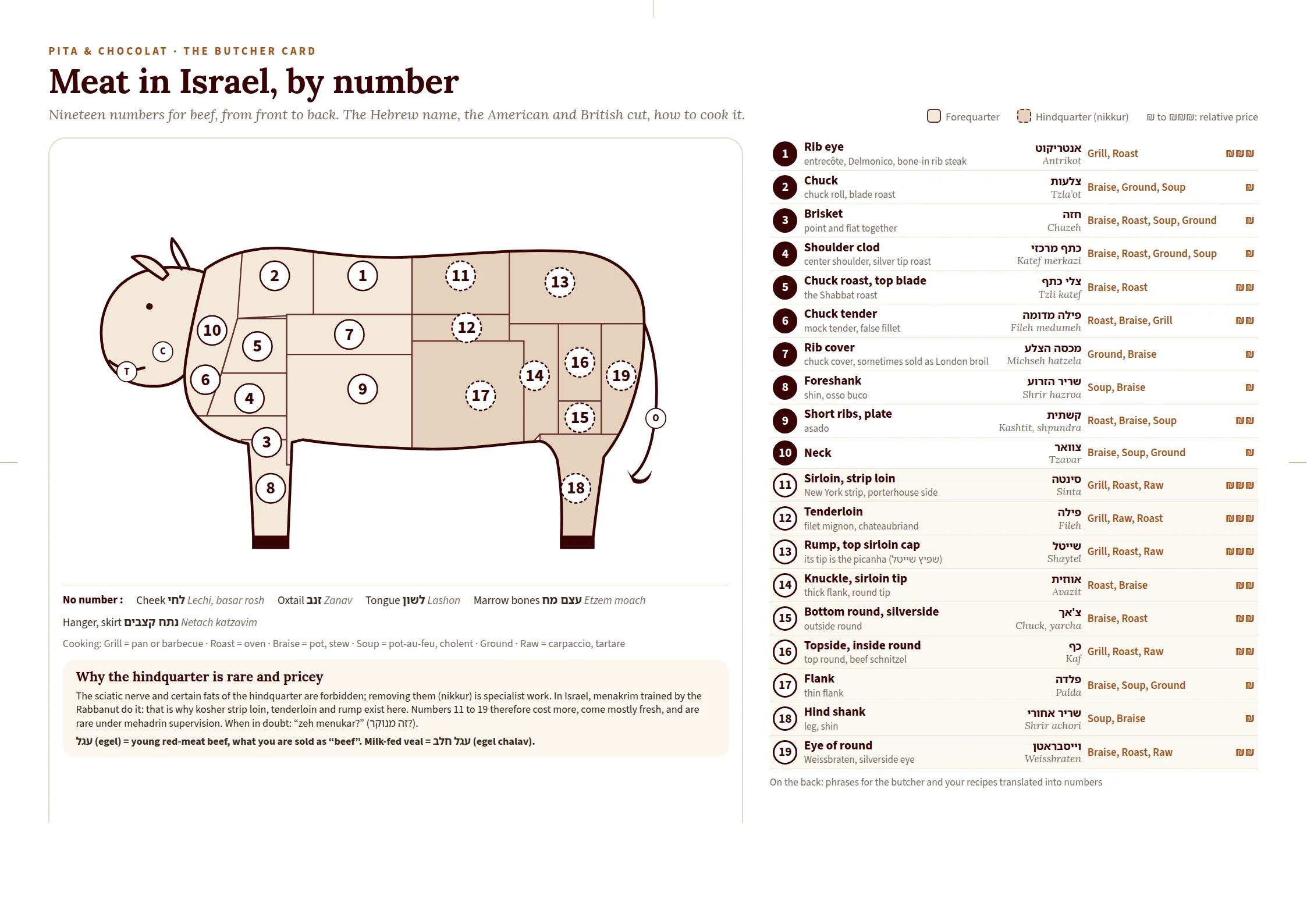
The 19 beef numbers, plus lamb and poultry, on a clickable drawing: what each cut is in American and British terms, how to ask for it in Hebrew, how to cook it, and the recipes on the blog that suit it.
At the butcher in Israel, meat comes in numbers. Here they are, one by one.
Nineteen numbers for beef, names borrowed from Yiddish, German and Argentine Spanish, and a counter where everything moves fast. Click a cut to learn what it is in American and British terms, how to ask for it in Hebrew, how to cook it, and which recipes on the blog suit it.
At the counter in Israel you do not ask for “chuck roast”, you ask for “a five”, and the words you overhear (ripen, shpundra, asado, polkeh) came over from Warsaw, Budapest or Buenos Aires. This guide translates both ways: from the number to the American or British cut, and from the recipe you are holding to the number to ask for.
Click the drawing, or open counter mode on your phone, standing in front of the display.
The map
Click a cut
Numbers run from the front (1 to 10) to the back (11 to 19). Tap a cut on the drawing or in the list.
Beef sold in Israel is almost always עגל (egel): a young, red-meat animal, not veal in the American sense. The numbers apply to both. Cuts 1 to 10 come from the forequarter, 11 to 19 from the hindquarter, which is rarer and pricier because it has to go through nikkur.
Dots rate tenderness for quick cooking and fat content, out of four. The ₪ signs place the price relative to the other cuts of the same animal, not in shekels: prices move, the gaps between cuts much less. “Forequarter” and “hindquarter” refer to kashrut, explained further down.
Support the blog
The printable butcher card, $6
The guide stays free. The butcher card is its pocket version: one A4 sheet, both sides, that folds into a wallet, with the numbered map, what to say to the butcher, the recipe-to-number matches and a lock-screen wallpaper for your phone. Every new version is sent to you for free.
Leviticus forbids the sciatic nerve (gid hanasheh) and certain fats (chelev), both in the hindquarter. Removing them is called nikkur (ניקור): specialist work, slow and costly. In the US and the UK almost nobody does it, which is why kosher beef there is forequarter only. In Israel, menakrim trained by the Rabbanut do it, and that is why you can find kosher strip loin, tenderloin, rump and topside here.
Three practical consequences. Numbers 11 to 19 cost more, because nikkur costs and the Rabbanut only allows it under supervision. You will find them mostly in the fresh section, rarely frozen. And most mehadrin supervisions (Badatz, Eda Charedit…) sell only the forequarter: if your standard is strict, the counter stops at 10. When in doubt ask “zeh menukar?” (זה מנוקר?), “has it had nikkur?”, and read the label.
Translate a recipe
My recipe says “chuck roast”. What do I ask for?
American and British recipes speak in cuts, the Israeli butcher in numbers. Here is the match, dish by dish; the first number is the one I buy most often.
No need for perfect Hebrew: these few phrases, pronounced as written, are enough to get exactly the cut you need. The button reads the phrase out loud when your device has a Hebrew voice.
Asking
מה טרי היום?Ma tari hayom?What is fresh today?
איזה מספר זה?Eizeh mispar zeh?What number is this?
כמה עולה הקילו?Kama oleh hakilo?How much per kilo?
זה טרי או מופשר?Zeh tari o mufshar?Is it fresh or defrosted?
זה מנוקר?Zeh menukar?Has it had nikkur? (hindquarter)
יש עגל חלב?Yesh egel chalav?Do you have milk-fed veal?
The cut
לחתוך לקוביות, לתבשילLachtoch le-kubiyot, le-tavshilCut into cubes, for a stew.
פרוס דק, לשניצלParus dak, le-shnitzelSliced thin, for schnitzel.
בעובי של שתי אצבעותBe’ovi shel shtei etzba’otTwo fingers thick.
עם עצם / בלי עצםIm etzem / bli etzemBone-in / boneless.
קשור, לצליKashur, le-tzliTied, for a roast.
לפתוח כמו ספרLiftoach kmo seferButterflied.
להשאיר את השומןLehash’ir et hashumanLeave the fat on.
לנקות מהגידיםLenakot mehagidimTrim the sinew.
How much
קילו וחצי, בערךKilo vachetzi, be’erechA kilo and a half, roughly.
חתיכה אחתChaticha achatIn one piece.
שני נתחיםShnei netachimTwo pieces.
לשישה אנשיםLe-shisha anashimFor six people.
Ground meat
טחון, פעם אחתTachun, pa’am achatCoarsely ground, once.
טחון פעמייםTachun pa’amayimFinely ground, twice.
טחון רזה, מכתףTachun razeh, mi-katefLean ground, from the shoulder.
טחון מצוואר וחזהTachun mi-tzavar ve-chazehNeck and brisket ground, the tastiest.
פרגית בלי עורPargit bli orBoneless, skinless thighs.
עצמות עוף למרקAtzamot of le-marakChicken bones for soup.
To finish
זה הכל, תודהZeh hakol, todaThat’s all, thank you.
שבת שלום!Shabbat shalom!Good Shabbat!
At the counter
Counter mode
A screen built to be read standing up, between two customers: type a number or a word, in English or Hebrew, and the answer shows up big. The screen stays on.
🐄 Beef בקר
#
English
Hebrew
Cooking
What it does best
1
entrecôte, Delmonico, bone-in rib steak
אנטריקוט Antrikot
Grill, Roast
A thick steak seared in a pan or on the grill, a bone-in rib roast for a big table, a festive roast beef.
2
chuck roll, blade roast
צלעות Tzla’ot
Braise, Ground, Soup
Goulash, Sunday stew, and meatballs that stay juicy: the tastiest ground beef at the counter.
3
point and flat together
חזה Chazeh
Braise, Roast, Soup, Ground
Braised brisket for hours, pulled beef, pot-au-feu, homemade corned beef and pastrami.
4
center shoulder, silver tip roast
כתף מרכזי Katef merkazi
Braise, Roast, Ground, Soup
Beef bourguignon, pot roast, the Friday braise, and lean ground beef.
5
the Shabbat roast
צלי כתף Tzli katef
Braise, Roast
The Shabbat roast par excellence, braised with onions or mushrooms: it slices neatly and stays moist reheated.
6
mock tender, false fillet
פילה מדומה Fileh medumeh
Roast, Braise, Grill
A pot roast that slices cleanly, or thin, well-marinated steaks.
7
chuck cover, sometimes sold as London broil
מכסה הצלע Michseh hatzela
Ground, Braise
Ground beef for kebabs, arayes and burgers, pulled beef, a long-simmered bolognese.
8
shin, osso buco
שריר הזרוע Shrir hazroa
Soup, Braise
Osso buco in bone-in slices, cholent, pot-au-feu, a soup that sets into jelly.
9
asado
קשתית Kashtit, shpundra
Roast, Braise, Soup
Slow-roasted asado, cholent, braised ribs in barbecue sauce.
10
צוואר Tzavar
Braise, Soup, Ground
North African stews, mloukhia, pkeila, couscous broth, ground beef.
11
New York strip, porterhouse side
סינטה Sinta
Grill, Roast, Raw
Steaks, pink roast beef, stir-fried beef strips.
12
filet mignon, chateaubriand
פילה Fileh
Grill, Raw, Roast
Tournedos, tataki, carpaccio, beef Wellington.
13
its tip is the picanha (שפיץ שייטל)
שייטל Shaytel
Grill, Roast, Raw
Steaks, skewers, schnitzel, roast beef, carpaccio. The tip, with its fat cap, on the grill: that is picanha.
14
thick flank, round tip
אווזית Avazit
Roast, Braise
A pot roast that slices cleanly, lean stew cubes, fondue bourguignonne.
15
outside round
צ'אך Chuck, yarcha
Braise, Roast
Pot roast, braised beef, pot-au-feu. Leave the thin fat cap on, it melts as it cooks.
16
top round, beef schnitzel
כף Kaf
Grill, Roast, Raw
Beef schnitzel and cutlets, thin steaks, roast beef, carpaccio, stir-fries.
17
thin flank
פלדה Palda
Braise, Soup, Ground
Soup, pot-au-feu, fatty ground beef for kefta, stuffed roulade.
18
leg, shin
שריר אחורי Shrir achori
Soup, Braise
Pot-au-feu, cholent, osso buco, soup.
19
Weissbraten, silverside eye
וייסבראטן Weissbraten
Braise, Roast, Raw
Pot roast, braised beef, and thanks to its even shape, carpaccio and tartare.
·
לחי Lechi, basar rosh
Braise, Soup
Pkeila, loubia, mloukhia, cheeks with cumin: gelatinous, it melts after three hours.
·
זנב Zanav
Soup, Braise
Pot-au-feu, daube, soup: it gives body to anything that simmers.
·
לשון Lashon
Soup, Braise
Poached two hours then peeled, in a sharp sauce or cold in slices with vinaigrette.
·
עצם מח Etzem moach
Soup, Roast
Pot-au-feu, broth, cholent, or roasted and spread on toast.
·
נתח קצבים Netach katzavim
Grill
Seared very hard, rare, sliced against the grain: the bistro steak.
🐑 Lamb טלה
#
English
Hebrew
Cooking
What it does best
·
צוואר טלה Tzavar taleh
Braise, Soup
Tagines, couscous, spring stews.
·
Israel’s leg of lamb
כתף טלה Katef taleh
Roast, Braise
Roasted four hours at low temperature, confit with herbs and garlic, as a mechoui: it falls apart with a spoon.
·
צלעות טלה Tzla’ot taleh
Grill, Roast
Grilled chops, a herb-crusted rack roasted pink.
·
חזה טלה Chazeh taleh
Roast, Braise
Slow-roasted then grilled, or braised with beans.
·
שריר טלה Shrir taleh
Braise, Roast
Braised shanks, lamb osso buco, one per person.
·
אוכף Ukaf
Roast, Grill
Roasted pink, in medallions.
·
שוק טלה Shok taleh
Roast
The Sunday roast leg. In Israel you take the shoulder, and you lose nothing.
·
טלה טחון Taleh tachun
Grill, Ground
Kebabs, kefta, arayes, moussaka.
🐔 Poultry עוף
#
English
Hebrew
Cooking
What it does best
·
cutlet: שניצל
חזה עוף Chazeh of
Grill, Roast, Ground
Breaded cutlets, nuggets, stir-fried chicken, poached breast for a salad.
·
Israel’s favorite cut
פרגית Pargit
Grill, Braise, Roast
Barbecue, skewers, homemade shawarma, braises with onions: juicy even overcooked.
·
ירכיים Yerechayim
Roast, Braise
Roasted with crisp skin, or in a tagine with olives.
·
שוקיים Shokayim
Roast, Grill
Roasted, caramelized with onions, fried: the kids’ cut.
·
כרעיים Kra’ayim
Roast, Braise
Friday-night chicken roasted with onions; confit legs; pastilla.
·
כנפיים Knafayim
Grill, Roast
On the barbecue, glazed in the oven, in the soup pot.
·
עוף שלם Of shalem
Roast, Soup
Roast chicken with herbs, chicken caramelized with onions, the Friday soup.
·
bones for the soup
שלד עוף Sheled of
Soup
The Friday chicken soup, matzo ball soup, the base of sauces.
·
כבד עוף Kaved of
Grill
Pan-fried with caramelized onions, as chopped liver, over mashed potatoes.
·
לבבות, קורקבנים Levavot, kurkevanim
Grill, Braise
Skewered on the barbecue, or slowly confit in oil.
Pink duck breast, home-cured duck breast, confit legs, the fat for roast potatoes.
Veal
And veal?
In Israel the word עגל (egel) means a young, red-meat animal: that is what you get when you ask for “beef”. For milk-fed, pale veal, ask for עגל חלב (egel chalav) or עגל צעיר (egel tza’ir). The numbers are the same: a blanquette uses milk-fed veal shoulder (4 or 5 in עגל חלב), veal chops come from 1, osso buco from 8.
Open a butcher shop in Tel Aviv in 1950: the butcher from Warsaw says ripen, the one from Budapest spondera, the one from Baghdad has an Arabic word, the one from Salonika a Ladino word, and the customer from Casablanca understands none of them. To get everyone on the same page, the Israeli beef cutting scheme was standardized into nineteen numbered cuts, from front to back. The number became the common language of the counter: you do not ask for “chuck roast”, you ask for “a five”.
The names still carry the trace of the immigrations. ריפען (ripen, the chuck) and וייסבראטן (Weißbraten, the eye of round) come from German and Yiddish; שפונדרה (shpundra) from the German Spannrippe, via Hungary; אסאדו from the Argentine barbecue; אנטריקוט and פילה from French; סינטה from the Italian scinta. As for שייטל, it is the same word as the wig worn by Orthodox women, because the rump sits on the hip like a cap.
Questions I get asked
Frequently asked questions
Which number for the Shabbat roast?
Number 5, צלי כתף, the chuck roast: that is literally its name, “shoulder roast”. Braised with onions the day before, sliced cold and reheated in its juices, it never fails. Number 4 (shoulder clod) is a bit leaner and cheaper, number 6 (chuck tender) slices more prettily.
Why is Israeli beef called “calf” (עגל)?
Because it is slaughtered young, at one or two years: a young, red-meat animal, not milk-fed veal. Real veal, pale, is called עגל חלב (egel chalav) and has to be ordered. The numbers are the same for both.
Fresh or frozen?
The forequarter is everywhere frozen, often imported and cheap: perfect for anything that braises. The hindquarter (11 to 19), offal and lamb are mostly in the fresh section. Defrost overnight in the fridge, never in warm water.
How do I get good ground beef?
By having it ground in front of you: a mix of rib cover (7) or chuck (2) for flavor, and shoulder clod (4) for structure. Ask for “tachun pa’am achat”, ground once, for burgers and kebabs that stay juicy. For fine meatballs, twice.
What does “tzli” (צלי) mean on the label?
“Roast”, meaning a cut to be cooked whole and slowly, in a pot or in the oven: צלי כתף (5), צלי קדירה (pot roast). It is not a roast beef to serve pink.
Where are hanger steak, skirt steak, flank steak?
Hanger and skirt (the diaphragm) are called נתח קצבים, “the butcher’s cut”, and you have to order them. Flank steak in the American sense has no number of its own: ask for flank (17) for a braising cut, or rump (13) sliced thin for a long-grained steak.
Why are tenderloin and rump so expensive?
Because they come from the hindquarter, which has to go through nikkur, specialist work, and because they are small: a tenderloin weighs two kilos on a three-hundred-kilo animal. Topside (16) and rump (13) give very honorable steaks for much less than 12.
Are the numbers the same everywhere in Israel?
Yes for the nineteen main cuts, from the supermarket to the neighborhood butcher. Nicknames change from one butcher to the next (ripen, shpundra, asado, polkeh…), which is why the number is the safe bet.
Support the blog
The printable butcher card, $6
The guide stays free. The butcher card is its pocket version: one A4 sheet, both sides, that folds into a wallet, with the numbered map, what to say to the butcher, the recipe-to-number matches and a lock-screen wallpaper for your phone. Every new version is sent to you for free.