Ingredients
Check off ingredients as you go
- 1 kg (8 cups) all-purpose flour (plain flour), sifted
- 16 g (5 tsp) active dry yeast
- 450 ml (scant 2 cups) warm water
- 100 g (1/2 cup) sugar
- 1 large egg (optional)
- 1 level Tbsp fine salt (20 g)
- 100 ml (⅓ cup + 1 Tbsp) neutral oil
For the glaze
- 1 whole egg, beaten
- Poppy, sesame or nigella seeds
Makes 4-6 loaves
- In a large bowl or the bowl of a stand mixer, dissolve the yeast in the warm water with a teaspoon of the sugar. Mix well and let stand for about 10 minutes, until it turns foamy.
- Add the beaten egg, the rest of the sugar, the oil and the salt. Start kneading and gradually pour in the sifted flour until you get a supple dough. Keep kneading for a good 10 minutes, until the dough is elastic, smooth and really only just barely sticky. If it is too sticky, add a little flour. Cover with plastic wrap or a clean kitchen towel and let rise in a warm spot for 1½ to 2 hours, or until doubled in size (for a slow rise, see the tips below).
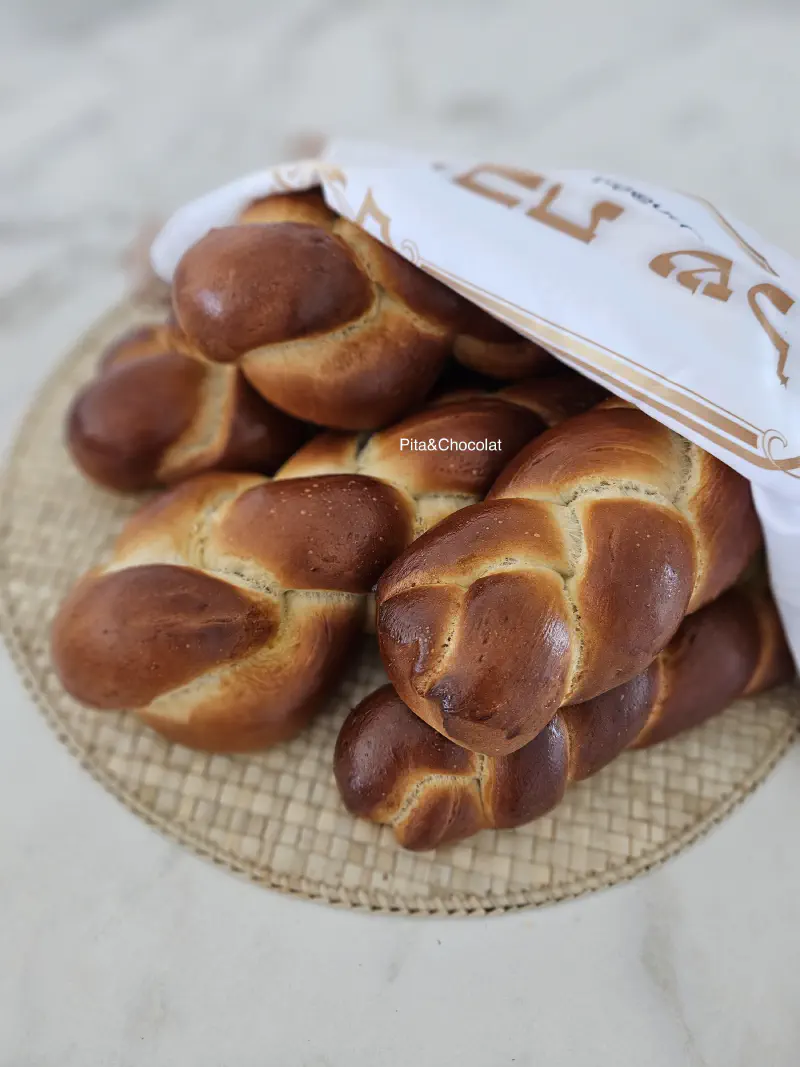
- Punch down the dough and divide it into eight equal pieces (weigh the whole dough and divide it so your loaves are even, about 200 g / 7 oz each). Braid them (see the animated braiding guide), then place the loaves on parchment paper, well spaced out, and lightly moisten them with water using a pastry brush or your hands. Let them rest covered with a clean kitchen towel until doubled in size (45 minutes to 1 hour); they should be puffy and look soft. Preheat the oven to 200°C (400°F). Brush with the beaten egg and, if you like, sprinkle with sesame, poppy or nigella seeds, or any other fun topping you love (flax seeds, flaky sea salt, rosemary, sumac, za’atar…). Bake on the middle rack, lower the temperature to 180°C (350°F) and bake for about 20 minutes.
Braiding, animated: 3, 4, 5 and 6-strand braids, the round challah for Rosh Hashanah, the key-shaped challah for the Shabbat after Passover, the wheat-sheaf challah for Shavuot… every move step by step, with a cooking mode that reads the steps out loud to you.
Open the braiding guide →Tips and planning
Do steps 1 and 2 the day before, cover and let the dough rise in the refrigerator overnight. This slow rise really gives the challah an incomparable softness, and it’s the way I recommend doing it. The next day, just take it out to come back to room temperature, then braid and carry on with the recipe as written.
The seeds stick to the bread better when you use a whole egg rather than just a yolk.
If the challah sounds hollow when you tap gently on the bottom, it’s done.
On the Shabbat after Passover, one custom is to shape the challah like a key.
At Purim, some people braid one very long challah, others make a triangle or pretzel shape to recall Haman’s ears.
At Shavuot, it is customary to shape them like Torah scrolls or sheaves of wheat.
Some people like to swap the neutral oil for olive oil.
- At Rosh Hashanah, you can shape them like pomegranates or apples!