BasicsBreadsJewish cuisineStep by stepShabbatRosh HashanaPurimPassoverShavuot

How to Braid Challah: the Animated Step-by-Step Guide

From the 3-strand braid to the round Rosh Hashanah challah, from the shlissel key to the Shavuot wheat sheaf: every move animated, with a hands-free kitchen mode that reads the steps aloud.

The animated guide

Every move, strand by strand, at the pace of your hands.

From the 3-strand braid to the queen of challahs with 6 strands, from the round Rosh Hashanah challah to the key challah after Passover and the Shavuot wheat sheaf: pick a shape, follow the animation step by step, and let the page read the moves aloud while your hands are in the dough.

Choose a braid
  • 6 braids and 11 festive shapes
  • Read aloud and voice commands
  • Screen stays on in kitchen mode

Braiding is the part of making challah that everyone dreads, and that everyone ends up loving. Once the dough from my challah recipe has risen and been divided, ten minutes of moves remain, always the same ones, and they decide how the bread will look on the Shabbat table.

This page is meant to be open while you braid, hands in the flour: every braid and every festive shape builds itself in front of you, step by step, and the kitchen mode reads each move aloud. Say “next” and the animation carries on, without touching the screen. Strands are always numbered from left to right and renumbered after every move: that is the only convention to remember.
Before you braid

The seven habits of a beautiful braid

Braiding starts long before the first crossing. These seven habits make the difference between a challah that keeps its pattern and one that opens up in the oven.

  1. Weigh, don’t guess

    Strands of equal weight give an even braid. Weigh the whole dough and divide by the number of strands. Guidelines: 100 g per strand for a 4-strand braid, 80 g for 5, 65 g for 6, or 150 g for large challahs.

  2. Round, then let rest

    Shape into balls, cover, and wait 10 to 15 minutes. If a strand springs back while you roll it, the gluten is tightening: don’t force it, let it rest another 5 minutes.

  3. Roll from the centre outwards

    Flatten the ball, roll it into a cigar, then roll with both hands from the centre outwards. Aim for 35 to 45 cm, slightly thicker in the middle and tapered at the ends. If one hand is stronger, flip the strand halfway.

  4. No flour on the work surface

    Rolling needs grip: a bare work surface, and barely damp hands if the dough slides. A light dusting of flour on the finished strands is enough to keep them from sticking to each other.

  5. Seal the top firmly

    Pinch the ends together and press: a loose seal opens in the oven (the famous “lobster claws”). Tip: braid from the middle for a symmetrical challah, without a big pinch at the top.

  6. Braid without pulling

    Lay the strands down rather than pulling them. Too tight, the dough tears and the braid “explodes” in the oven; too loose, it slumps. A relaxed braid leaves room for the rise.

  7. Seal the bottom, tuck it under

    Pinch the ends, roll them lightly to taper them, and slide them under the braid. Then egg wash right away (it holds better on firm dough), rise 45 to 60 minutes, a second light wash, seeds, oven.

The braids

Choose your braid

Every braid reads the same way: strands are numbered 1 to n from left to right, and renumbered after every move. Click a braid to open it in the workshop.

  • 3-strand braid

    The one you learn first, and never get wrong.

    Shabbat · Every day
  • 2-strand twist

    Two strands wound together: the simplest move, and the shaft of the key challah.

    Rolls · Key challah
  • 4-strand braid

    Tall, with a beautiful ridge down the middle. The mantra: 1 over 3, 2 over 3, 4 over 2.

    ●● Shabbat · Holidays
  • 5-strand braid

    A pretty central ridge, and the same rhythm as the 4-strand: 1 over 3, 2 over 3, 5 over 2.

    ●●● Shabbat · Holidays
  • 6-strand braid

    The queen of challahs: tall, round, and two 6-strand challahs make twelve, like the twelve loaves of the Temple.

    ●●● Shabbat · Holidays · Big tables
  • 8-strand braid

    For holidays and big tables. Four moves, one rhythm, and a lot of effect.

    ●●●● Special occasions

The workshop

Step by step, at your own pace

Festive shapes

Rounds, keys, scrolls, sheaves…

Every holiday has its shape, and every shape tells a story. Click one to watch it take shape in the workshop.

  • Round spiral challah

    The Rosh Hashanah challah: no beginning and no end, like the year that starts again.

    Rosh Hashanah · Yom Kippur · Sukkot
  • Woven round challah, 4 strands

    The famous “tic-tac-toe” weave: four strands, eight ends, and a spectacular braided basket.

    ●●● Rosh Hashanah · Holidays
  • Braided crown

    A 3-strand braid closed into a ring: a crown for the King of kings.

    Rosh Hashanah · Shavuot · Buffets
  • Knotted rolls

    One strand, one knot, one roll. Perfect for children and big tables.

    Shabbat · Individual portions · Kiddush
  • Torah scroll

    Two scrolls facing each other: the Sefer Torah, for the festival of the giving of the Torah.

    Shavuot · Simchat Torah
  • Wheat sheaf

    A rope, a pair of scissors, and the sheaf of the harvest festival.

    Shavuot · Sukkot
  • Key challah (shlissel challah)

    The key to parnassah: a Hasidic custom for the first Shabbat after Passover.

    ●● Shabbat after Passover
  • Apple challah

    A little apple of dough, to dip in honey: children love it.

    Rosh Hashanah
  • Pomegranate challah

    613 seeds, like the 613 mitzvot: the Rosh Hashanah pomegranate, challah version.

    Rosh Hashanah
  • Ladder

    So that our prayers rise: Jacob’s ladder, or the seven steps of Sinai.

    Rosh Hashanah · Yom Kippur · Shavuot
  • Two-tier braid

    A small braid on top of a big one: the bakery look, without the difficulty.

    ●● Shabbat · Holidays · Weddings

Support the blog

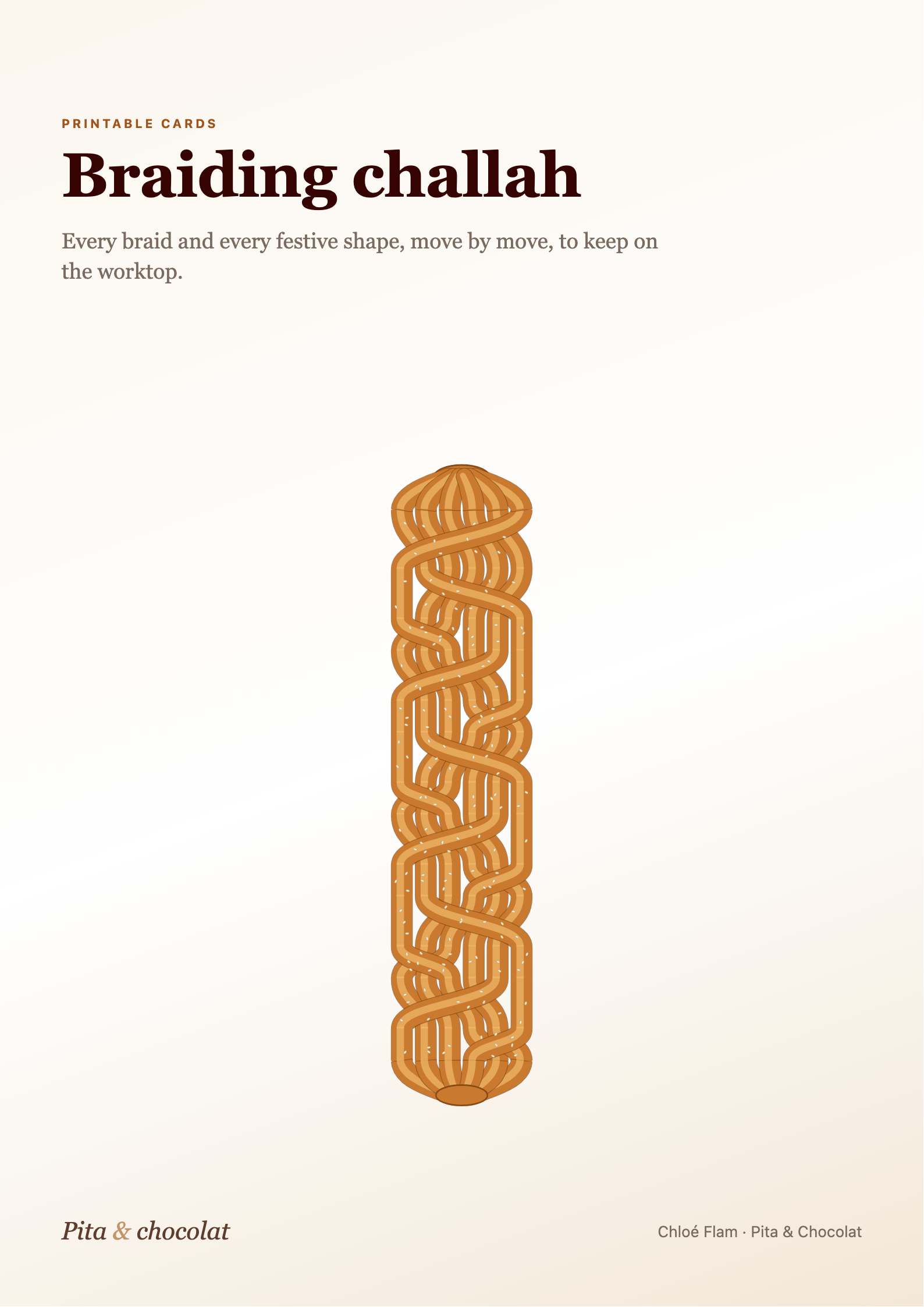
The printable cards, $6

The guide stays free. For those who want to support it and keep it in front of them, hands in the flour: a 21-page PDF, one braid per page with its mantra and the result of every move, all the festive shapes, the calendar and the troubleshooting.

Get the cards →

The calendar

Which shape for which holiday?

Shabbat

Every week

Two loaves (lechem mishneh) recalling the double portion of manna on Fridays, covered with a cloth as the manna was covered with dew. The braid sets the Shabbat bread apart from everyday bread; the intertwined strands evoke arms embracing.

Rosh Hashanah

1 and 2 Tishrei

Round: the cycle of the year starting again, the crown of the King of kings, a long life without end. It is dipped in honey. Some add a ladder (our prayers rising) or a bird, or shape it as an apple or a pomegranate.

Eve of Yom Kippur

9 Tishrei

Still round, often topped with a ladder or a bird: “as birds hovering, so will the Lord protect Jerusalem” (Isaiah 31:5). Some families also make outstretched hands.

Sukkot & Hoshana Rabbah

15 to 21 Tishrei

Round until the end of the Tishrei festivals. On Hoshana Rabbah, the day of the final verdict, a hand stretched towards Heaven, or a ladder.

Hanukkah

25 Kislev

No traditional shape, but today’s bakers have fun: a menorah made of ropes, braids dusted with sugar… and above all, doughnuts.

Tu BiShvat

15 Shevat

The new year of the trees: challahs with dried fruit, a “trunk” braid that opens into branches, or balls filled with figs and dates.

Purim

14 Adar

A very long braid (the keylitsh), recalling the rope of Haman’s gallows, or small triangular challahs like his ears. In Morocco, the ojos de Haman enclose hard-boiled eggs that are “plucked out” at the table.

Shabbat after Passover

Shlissel challah

The key challah: for parnassah and the gates of Heaven still open. An 18th-century Hasidic custom, shaped like a key or with a key hidden inside.

Shavuot

6 Sivan

The giving of the Torah and the harvest festival: Torah scroll, seven-rung ladder (the seven heavens of Sinai), wheat sheaf, tablets of the Law. Shavuot challahs are often made with milk or honey.

A bit of history

Why braid at all?

Why braid? Because the Shabbat bread must stand apart from weekday bread. The braid comes from Central Europe, where the 15th-century berches, a Sunday festive bread, was adopted by Ashkenazi communities for Shabbat. Kabbalists saw letters and numbers in it: each 6-strand challah looks like the letter vav (six), and two challahs make twelve, the twelve showbreads of the Temple, the twelve tribes. Some read three braids for Creation, the Exodus from Egypt and the world to come.

Among Sephardim, the Shabbat bread is often round or oval, unbraided, scented with aniseed or sesame seeds; the braid crept in over time. As for the word “challah”, it first refers to the portion of dough set aside and burnt in memory of the offering made to the Kohanim, hence the gesture, before braiding, of “taking challah” when kneading a large quantity of dough (without a blessing from about 1.2 kg of flour, with a blessing from about 1.7 kg; ask your rabbi for the exact amounts).

Troubleshooting

The questions I get asked

My braid opens up and loses its shape in the oven

Three possible causes: a braid that is too tight (the dough has no room and tears), too short a rise after braiding (the strands separate as they puff up), or badly sealed ends. Braid relaxed, let it rise until a fingertip leaves a dent that springs back slowly, and pinch the ends firmly before tucking them under.

My strands shrink when I roll them

That is the gluten tightening. Cover and let rest 5 to 10 minutes, then try again: they will stretch effortlessly. Never force it, the dough would tear.

The braid loses its pattern as it rises

It probably over-proofed, or the dough is too soft. Tapered strands, a loose braid, a first egg wash right after braiding and a watched rise (puffy but not wobbly) keep the relief. If you see the strands starting to separate, bake.

Should I use flour?

Not on the work surface: rolling strands needs grip. A light dusting of flour on the finished strands keeps them from sticking to each other and keeps them distinct during the rise. If the dough sticks to your hands, dampen them slightly rather than flouring.

One egg wash or two?

Two: one right after braiding, when the dough is firm and the brush reaches every hollow, and a second, very light one, just before baking. An egg yolk with a spoonful of water and a pinch of sugar gives the best shine. Don’t let the egg run into the grooves: it would burn there.

How do I make the seeds stick?

On the second egg wash, just before the oven. For fully coated strands, bakery-style: roll each strand on a damp tea towel, dredge it in seeds like a cutlet, wait 3 minutes for it to relax, then braid.

Can I freeze it?

Yes, in three ways: the dough after the first rise, the braided and egg-washed challah (take it out 5 hours before baking), or the baked challah, reheated 10 minutes in the oven. Braid double, freeze half: next Shabbat is already sorted.

How can I practise without wasting dough?

With string, ribbons or modelling clay: say the mantra out loud as you go. The “kitchen mode” on this page can dictate every move, without touching the screen.

Support the blog

The printable cards, $6

The guide stays free. For those who want to support it and keep it in front of them, hands in the flour: a 21-page PDF, one braid per page with its mantra and the result of every move, all the festive shapes, the calendar and the troubleshooting.

Get the cards →

And the dough?

My challah recipe, soft and golden

It all starts there: a supple dough, a slow rise in the fridge, and strands weighed to the gram. The full recipe, with adjustable quantities.

See the challah recipe →

Braided challahs
You've successfully subscribed to Pita & Chocolat!