
Ingredients
Check off ingredients as you go
Makes 1 large focaccia (30x40 cm / 12x16 in, or 28x35 cm / 11x14 in)
- 500 g (4 cups) bread flour (you can mix in some spelt flour)
- 380 ml (1½ cups + 1 Tbsp) water
- 4 g (1 tsp) active dry yeast or 12 g (0.4 oz) fresh yeast
- 10 g (2 tsp) fine salt
- 1 Tbsp honey or light brown sugar
- 4 Tbsp (45 g) olive oil
- herbs (thyme, herbes de Provence, rosemary)
- a little flaky sea salt (fleur de sel) to finish
In a large bowl, dissolve the yeast in the lukewarm water with the honey, then add the flour, followed by the fine salt and olive oil. Mix with a wooden spoon until just combined, cover and refrigerate for at least 12 to 16 hours, ideally 24 hours.
When you take the dough out, it should have risen well and be full of bubbles. Since it’s a very high-hydration dough, it’s very sticky, and that’s normal.
Generously oil a baking sheet (a jelly roll pan works well) and, using a rubber spatula or a bench scraper, gently transfer the dough onto it. The secret to a successful focaccia is to keep the air in the dough and add a little more, to get those famous holes. Very gently stretch the dough (oil your hands) into a rough rectangle, then fold each side in like an envelope. Turn the dough and repeat the operation twice. No need to flour anything: with oiled hands you should be fine. Your dough should now look nice and plump. Run your oiled hands over the whole surface, cover and let rise for 20 minutes.
With oiled hands, gently stretch your focaccia dough into a large rectangle (if the dough resists, do it in 2 stages, letting it relax for 15 minutes before trying again). If you shape a thick rectangle, you’ll get a very soft, fluffy focaccia that you can fill like a sandwich; if you stretch it thinner, you’ll get a true focaccia with an open, airy crumb (those famous bubbles), perfect alongside an Italian meal. I often divide the dough in two to make one of each. Let rise for 30 to 45 minutes at room temperature. The dough should be puffy and jiggly.
Meanwhile, preheat the oven on conventional heat (no fan/convection) to 230-250°C (450-480°F): the idea is to get heat that comes close to a pizza oven.
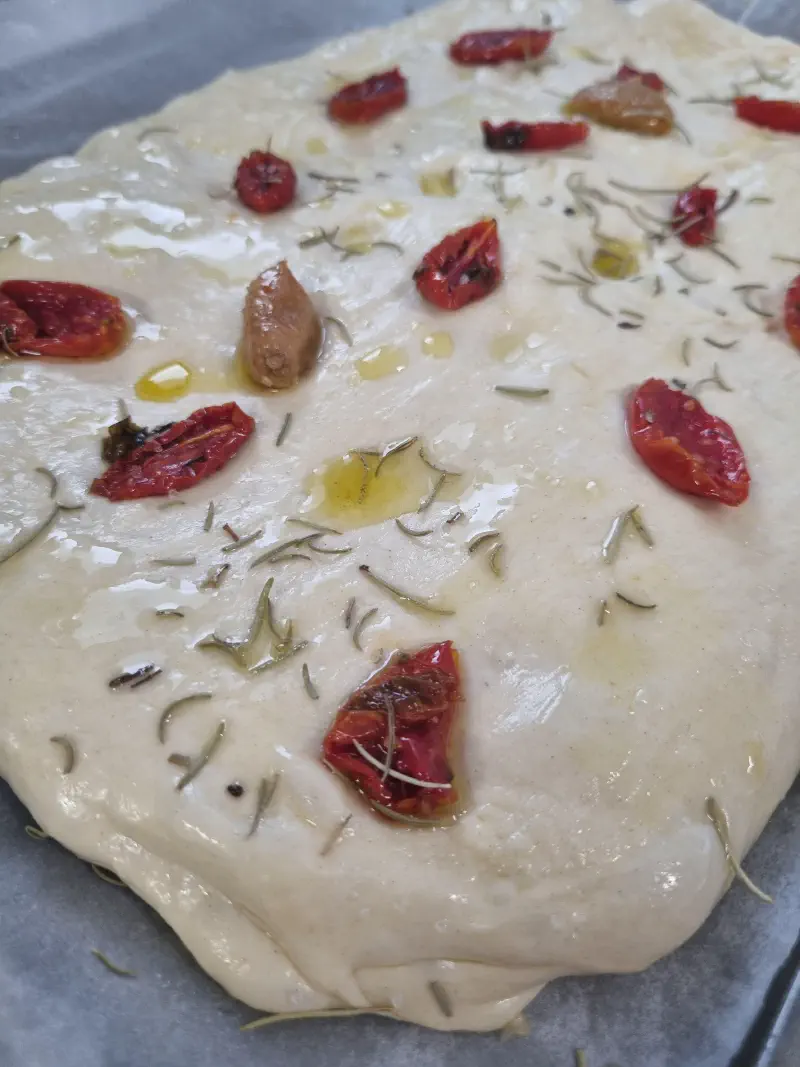
Pour olive oil generously over the top, dimple it all over with your fingertips (those characteristic little dents), then sprinkle with flaky sea salt and, if you like, garlic confit, cherry tomatoes, rosemary… Bake on the lowest rack for about 18 to 25 minutes, depending on thickness. It should be nicely golden. In a small bowl, mix 3 Tbsp water and 3 Tbsp olive oil and brush over the focaccia as soon as it comes out of the oven. Let cool for a few minutes before slicing with a bread knife, and enjoy.
Tips
- When I say bread flour, I mean a flour that is high in protein; check the back of the bag, it should be around 11-12%.
- For an even more fragrant focaccia, brush it with flavored oil (garlic, tomato or whatever you like).
- If your oven goes up to 280°C (535°F), it will probably be done in 10 minutes, so keep a close eye on it!
- Use this dough to make a rectangular Roman-style pizza, like the ones sold al taglio (by the slice).
- If you’re after an even more open crumb, do this: mix the ingredients as directed, let rest for 20 minutes at room temperature, then do 4 successive folds. Let rest again for 20 to 30 minutes, do another round of folds and refrigerate overnight or, better still, for 24 to 36 hours. Then proceed as directed.
- If the high hydration doesn’t scare you, increase the water to 400 ml (1⅔ cups) and use pizza flour.
- The baking temperature affects the final texture: if you bake at a lower temperature for longer, you’ll get a soft center with a crispy top. For a crispier, firmer texture, it’s better to bake hotter for a shorter time. Test and adjust to your taste and your oven.